The Philippines is in the middle of something exciting.
The country's ICT market hit USD 43.7 billion in 2025. More Filipino businesses than ever are moving to the cloud, adopting digital tools, and reaching customers in ways that simply weren't possible five years ago. In March 2026, Converge ICT broke ground on a PHP 5 billion data centre in Pampanga. This is a signal of just how seriously the country is investing in its digital future.
This momentum is real, and it's worth celebrating. But growing businesses often ask us the same question as they scale: "Are we protected enough to keep going?"
It's a good question to ask. And asking it early is exactly what separates businesses that grow with confidence from those that get caught off guard.
What the Threat Landscape Actually Looks Like
Here's an honest picture of where things stand.
84.5% of Philippine organisations experienced a cybersecurity breach in 2024
The most common being phishing, ransomware, and supply chain breaches. Phishing sites targeting Philippine users jumped 423% in 2025. Ransomware cases nearly doubled in the same period.
In 2023, the Philippine Health Insurance Corporation was hit by the Medusa ransomware gang. 430 gigabytes of data were stolen, affecting over 42 million members. When the investigation concluded, the cause wasn't a sophisticated zero-day exploit. PhilHealth had been running expired antivirus software. The breach was entirely preventable.
That's actually the encouraging part of that story: most successful attacks don't exploit cutting-edge vulnerabilities. They exploit gaps that are well understood and fixable. Example, outdated software, misconfigured systems, weak access controls, untrained staff. The businesses that get this right aren't necessarily spending more. They're just being deliberate about the basics.
The New Variables: AI and the Evolving Attack Surface
What has genuinely changed in the last two years is how attackers operate, and AI is at the centre of that shift.
Phishing emails are no longer easy to spot. AI-generated messages are grammatically flawless, contextually convincing, and personalised at scale, with click-through rates more than four times higher than human-written ones. Deepfake technology, once a curiosity, is now being used in 40% of Business Email Compromise attacks globally. That means someone on your finance team could receive what looks like a video call from your CEO requesting an urgent transfer, and it may not be real.
None of this is meant to overwhelm. It's meant to shift the frame: the question is no longer "could this happen to us?" but "are we set up to catch it when it does?"
The same AI being used by attackers is equally powerful in defence by detecting unusual patterns, automating responses, and flagging threats before they become incidents. Businesses investing in AI-assisted security today are building a meaningful advantage for the years ahead.
Where Most Growing Businesses Actually Stand
The honest reality for many SMBs in the Philippines is that security has been reactive rather than proactive, not because of negligence, but because there's always something more immediate to focus on when you're growing.
Only 23% of Filipino SMEs currently have a formal cybersecurity policy. Meanwhile, 67% of Filipinos now use digital financial services. That gap between how digitised businesses have become and how protected they actually are, is where most of the risk lives.
The good news: that gap is very closable. And businesses that close it early don't just reduce risk — they gain something valuable. Customers trust them more. Partners feel more confident working with them. And as the Philippines' compliance environment tightens. With the Konektadong Pinoy Act (RA 12234) now in force and the BSP issuing new cybersecurity circulars for financial institutions, being ahead of regulation is a real competitive advantage, not just a checkbox.
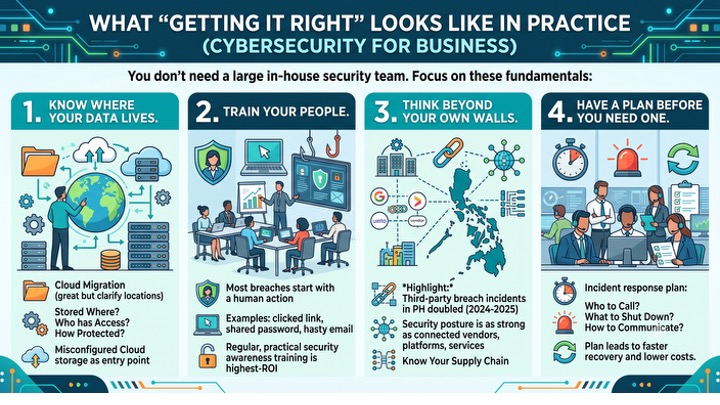
What "Getting It Right" Looks Like in Practice
You don't need a large in-house security team to be well-protected. What you do need is clarity on a few fundamentals:
1. Know where your data lives
Cloud migration is great, but only when you know what's stored where, who has access, and how it's protected. Misconfigured cloud storage is one of the most common entry points attackers exploit.
2. Train your people
Most breaches start with a human action. Example: a clicked link, a shared password, an email replied to in haste. Regular, practical security awareness training is one of the highest-ROI investments a business can make.
3. Think beyond your own walls
Third-party breach incidents in the Philippines doubled between 2024 and 2025. Your security posture is only as strong as the vendors, platforms, and cloud services connected to your business. Know your supply chain.
4. Have a plan before you need one
An incident response plan doesn't need to be a 50-page document. It needs to answer: who do we call, what do we shut down, and how do we communicate? Businesses with a plan recover faster and spend less when incidents happen.
Growing with Confidence
Security doesn't have to be a burden. When it's done well, it's what allows a business to move faster and to adopt new tools, enter new markets, and serve customers digitally.
Netron has had a local presence in the Philippines for years, and we recently deepened that commitment by joining the FinTech Philippines Association as an advisory member. Our Manila team works with SMBs across the Philippines. We bring multi-cloud and cybersecurity expertise across AWS, Google Cloud, Microsoft Azure, Oracle Cloud, Cloudflare, Palo Alto as well as the AI infrastructure capabilities of the NAVI platform.